


Papathanasiou, Athanasios
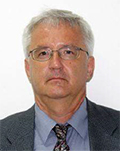
Professor, PhD'91 McGill University, Canada
Multi Scale Composites and 2D materials; Manufacturing; Structure/Property Correlations in fibrous and flake composites✉ athpapathan (at) uth.gr
Office Hours: By appointment
Short Biography
Dr. Papathanasiou received his Diploma in Chemical Engineering from NTUA in 1985, his MSc in Chemical & Petroleum Engineering from the University of Calgary (1987) and his PhD from McGill University (1991) with specialization on injection molding, under the supervision of Prof. M.R. Kamal. He joined the ME Faculty at Volos in 2008. His research has been funded by the US-DOE, US-DOD and US-NSF, as well as by the EU through a European International Integration Grant in 2007.
Research Interests
I am interested in the investigation of processing-structure-property relationships
in composite materials, as a prerequisite to optimal process and product
design. Processes of interest involve either flow into complex cavities or
channels (injection molding, calendering) and through fibrous media of complex
internal structure (liquid molding, pultrusion) or transport in filled systems.
Key to our approach is the use of computation to investigate the influence of
microstructure on the details of the flow fields (processing-microstructure
correlations) as well as on the details of concentration, thermal or stress
fields (microstructure-property correlations). In addition we are interested in
developing and testing realistic CAD models for composites manufacturing
processes, with recent emphasis in die- and pin-assisted pultrusion and a continuing interest in injection molding. Some specific projects are outlined below:
Micro-Scale Flows
in Fibrous Media: We are interested in the computational investigation of
flow patterns in fibrous media of complex internal structure, such as those
encountered in liquid molding of high performance composites or in transport
through biological media, and the determination of how such patterns are
affected by microstructural details. Both Stokes’ and finite Reynolds-number
flows as well as flows of micropolar fluids are considered. The long-term
objective is the development of quantitative models for the effective
permeability (K) of fibrous media as function of microstructural parameters.
Flow through Dual-Scale Porous Media: Such media are ubiquitous in the area of composites
fabrication, where different types of reinforcement in different stages of
orientation and aggregation are combined to produce preform architectures with
optimal processability and products with optimal on-site performance. Our work
here is aimed at elucidating the micro-scale flow patterns occurring in these
materials and, specifically, the interplay between micro- and macro-scale
flows.
Transport across filled systems: We are using high performance computing (based on the
BEM and the FVM) to investigate the manner in which the efficacy of filled
systems is affected by their internal structure. Systems of interest include
flake-filled membranes and particulate/fiber composites in which the dispersed
phase shows various degrees of aggregation.
Realistic Modeling of Polymer/Composites Manufacturing
Operations: We are interested in developing and
using realistic CAD models for polymer manufacturing processes (see Figure),
especially processes which make use of flow and geometry to achieve the
infiltration of a resin into a fibrous/porous scaffold. Our objective is to
combine large numbers of CAD results in order to propose and test explicit
process models relating material and process parameters to fabrication outcomes
– in the case of pin-assisted pultrusion, such a model for the extent of resin
infiltration was recently proposed