


Open call for applications for the MSc in SCML 2026–2027 (in Greek). Deadline: Monday, August 31, 2026.
Engineering tomorrow's supply chains

The Master of Science (MSc) in Supply Chain Management and Logistics (SCML) program, offered by the Department of Mechanical Engineering, trains the next generation of engineers and supply chain professionals to design, optimize, and manage complex logistics networks.
Focusing on the balance between supply and demand, value creation, and resilience, the program combines theoretical foundations, quantitative tools, and practical skills for addressing real-world operational challenges.
These are two distinct but inextricably linked fields:
- Logistics Management focuses on the physical flow and storage of goods, ensuring the efficient movement of inventory from the point of origin to the point of consumption.
- Supply Chain Management (SCM) is the broader strategic function that coordinates all business processes among multiple partners—from procurement and production to warehousing and distribution.
The SCML program focuses on an in-depth understanding of both, aiming for their integrated and strategic management.
Who is this MSc for?

The MSc in SCML is primarily intended for candidates with a strong quantitative or computational background.
It is particularly suitable for engineers, graduates of mathematics, statistics, physics, computer science, and other programs with demonstrably strong quantitative or computational content.
The program requires an interest in, and readiness for, quantitative analysis, modelling, and the use of computational tools.
Program profile
- Year established: 2018.
- Duration of studies: 3 semesters (full-time) or 5 semesters (part-time).
- Extension option: Up to 2 additional semesters (beyond the standard duration).
- Program requirements: 8 courses & Master’s Thesis (90 ECTS total).
- Mode of delivery: 100% online, with synchronous evening classes.
- Tuition fees: €3,600 (total cost for the standard duration).
- Extension cost: €330 per semester (applies only to studies beyond the standard duration).
- Fee waiver: Provided for 30% of entrants (based on economic/social criteria).
Student flow indicators
- Acceptance rate (admitted/applied): 36%.
- Yield rate (enrolled/admitted): 92%.
- Graduation rate (graduated/enrolled): 71%.
Program philosophy: Engineering foundations meet digital transformation

The program builds a solid foundation in the operational requirements of global logistics while equipping students with the analytical tools required for modern decision-making. Teaching focuses on four pillars:
- Supply chain engineering fundamentals: Mastering physical processes: design, planning, and control of procurement, transportation, warehousing, production, and distribution. Fundamental knowledge for designing efficient systems.
- Quantitative methods & operations research: Use of advanced tools (optimization, simulation, systems analysis) for designing complex networks (e.g., routing, facility location, production flows).
- Digital & disruptive technologies: Application of cutting-edge technologies (Artificial Intelligence, Machine Learning, Automation, Big Data) to create intelligent logistics systems.
- Green & resilient logistics: Designing sustainable supply chains capable of recovering from disruptions, integrating environmental responsibility and risk analysis into strategic decision-making.
Curriculum

Key characteristics
- Degree title: The program awards a Master of Science (MSc) in “Supply Chain Management and Logistics”.
- Type of study: Offered in full-time or part-time mode. Part-time attendance is granted upon submission of a reasoned request for employed students, or due to health, family, or other serious reasons, as per the Master’s Program Internal Regulations.
- Duration: Studies last three (3) semesters for full-time students and five (5) for part-time, with the right to suspend studies for up to two (2) semesters for serious reasons.
- Program requirements: Successful examination in eight (8) core elective courses (7.5 ECTS each), four (4) per semester for the 1st and 2nd Semesters, and the completion of a Master’s Thesis (30 ECTS – 3rd Semester) are required.
- Failure in a course – dismissal: In the event of failure in a course, the student is re-examined during the September resit examination period; if the student fails a second time, they may be dismissed from the MSc program by decision of the Department Assembly.
Program structure
1st (winter) semester (students choose four (4) out of the five (5) core elective courses)
- ΔΕΑL0101: Strategic Transportation-Logistics Management
- ΔΕΑL0102: Optimization Methods and Tools
- ΔΕΑL0103: Analysis of Production-Inventory Systems
- ΔΕΑL0104: Design and Operation of Logistics Facilities
- ΔΕΑL0105: Forecasting & Inventory Management
2nd (spring) semester (students choose four (4) out of the five (5) core elective courses)
- ΔΕΑL0201: Sustainable & Green Supply Chain & Logistics
- ΔΕΑL0202: Transportation-Logistics Network Algorithms
- ΔΕΑL0203: Supply Chain Simulation
- ΔΕΑL0204: Artificial Intelligence and Machine Learning
- ΔΕΑL0205: Procurement & Supply Chain Coordination
3rd (winter) semester
- MSc Thesis
Course focus areas
- Optimization/modeling: ΔΕΑL0102, ΔΕΑL0201 – Modeling and solving real-size optimization problems.
- Network algorithms: ΔΕΑL0101, ΔΕΑL0202 – Graph algorithms, routing, and flows.
- Systems analysis: ΔΕΑL0103, ΔΕΑL0105, ΔΕΑL0203, ΔΕΑL0205 – Stochastic modelling, forecasting, inventory theory, queuing theory, and simulation.
- Digital systems and data analysis: ΔΕΑL0204 – Artificial intelligence, machine learning, deep learning, and Python/R programming.
Competitive advantages

The program’s unique position within the Engineering School and the Department of Mechanical Engineering ensures a rigorous, quantitatively and technologically focused education with the following advantages:
- Quantitative basis with an engineering approach: Emphasis on optimization, simulation, and data analysis for practical problem-solving.
- Faculty excellence: Taught by faculty members and distinguished executives with international research presence and industry experience.
- Flexibility: Evening classes and remote attendance, ideal for working professionals and students outside of Volos.
- Market connection: Curriculum adapted to modern market needs and enriched with specialized seminars.
Alumni testimonials
The program’s strong focus on information systems and technology greatly helped me adapt to the professional path I chose immediately after graduation.
— SCML MSc Graduate ’21 Logistics Implementation ConsultantI became familiar with programming languages and software tools, and I learned how to structure my thinking in order to solve realistic problems effectively.
— SCML MSc Graduate ’22 Vessel & Berth PlannerThe program contributed significantly to my understanding of inventory management, ordering processes, and the use of mathematical models, forecasting methods, and programming for problem solving.
— SCML MSc Graduate ’21 ERP ConsultantTeaching faculty

The program is organized by Professors from the Division of Production Management and Industrial Administration within the Department of Mechanical Engineering and is supported by experts from the wider university and industry.
Academic supervisors (Department of Mechanical Engineering)
- Professor Konstantinos (Kostas) Ampountolas: Control and optimization of transport and traffic networks.
- Professor Athanasios (Thanasis) Ziliaskopoulos: Optimization models, transport systems, and logistics.
- Associate Professor George Kozanidis: Optimization algorithms, resource and maintenance scheduling.
- Professor George Liberopoulos: Stochastic models, production/inventory management, and energy markets.
- Professor Dimitrios (Dimitris) Pandelis: Operations research, stochastic control, and flexible production systems.
- Associate Professor Georgios (George) Saharidis: Mathematical programming, environmental routing, and green transport.
Collaborating instructors & experts
- Stamatis Adrianopoulos (Dipl. Mechanical Engineer): Founder of PLANNING S.A., with experience implementing 400+ logistics projects.
- Professor Stelios Koukoumialos (University of Thessaly): Stochastic models and supply chain simulation.
- Dr. Athanasios (Thanasis) Lois: Specialization in optimization algorithms and multimodal transport software.
Organization of studies & tuition fees

Teaching methodology
- Mode: 100% 100% online, through real-time videoconferencing.
- Schedule: Evening hours (typically 18:00 – 21:00), once a week per course.
- Language: Greek or English; most course materials are in English.
Fees & benefits
- Total cost: €3,600.
- Payment method (full-time): €1,200 per semester (for the first 3 semesters).
- Payment method (part-time): €720 per semester (for the first 5 semesters).
- Study extension: €330 per additional semester (maximum 2 semesters).
- Fee waiver: Available for up to 30% of students (based on Law 4957/2022 and income/social criteria).
- Scholarships & research: Possibility of excellence scholarships and paid participation in research projects, subject to resource availability.
Admission requirements & selection criteria

The MSc accepts graduates of Greek universities and Higher Military Educational Institutions, as well as graduates of recognized equivalent institutions abroad, who have a relevant academic background and/or strong quantitative, analytical, and computational skills.
Eligible applicants typically include graduates of:
- Schools of Engineering, such as Mechanical, Chemical, Electrical, Civil, Production and Management, Financial and Management Engineering, Computer Engineering, Information and Communication Systems Engineering, and Applied Mathematics.
- Schools of Science, such as Computer Science, Mathematics, Statistics, and Physics.
- Schools of Management and Economics, such as Management Science and Technology, Industrial Management and Technology, Supply Chain Management, Shipping Studies and Business Services, Economics, Business Administration, and related fields.
- Higher Military Educational Institutions, particularly in Engineering, Mathematics, Computer Science, and Supply Corps specializations.
Applications from graduates of other relevant higher education departments are also considered, provided that candidates have an appropriate academic background, relevant skills, and a documented interest in Supply Chain Management and Logistics.
Professional experience alone in logistics, procurement, warehousing, transportation, or management positions does not substitute for the need for an appropriate quantitative and analytical background.
For the winter semester (start: September):
- 1st call: May – July.
- 2nd call: July – September.
For the spring semester (start: February):
- call: December – January.
- Application form (available on the program website).
- Copy of Diploma/Degree or a responsible declaration that graduation is expected before the start of classes.
- Academic transcript.
- Certificate of sufficient knowledge of the English language (e.g., C1 level, etc.).
- CV with details of professional and research activity.
- Two recommendation letters.
- Degree grade (minimum “Very Good”): 30%
- Relevance of studies: 30%
- Knowledge of English: 10%
- Professional experience: 10%
- Recommendation letters: 10%
- Research activity (publications/conferences): 5%
- Possession of a second Master’s degree: 5%
Note: An interview may be conducted to clarify details.
Alumni
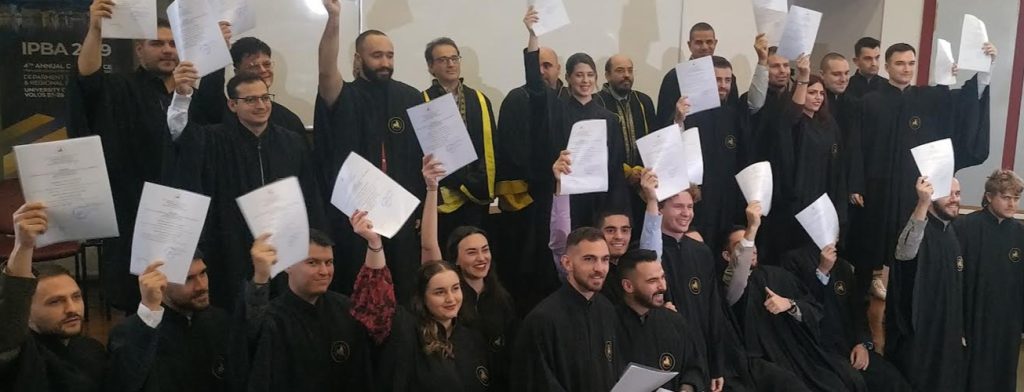
The program offers more than just academic knowledge; it provides entry into a dynamic professional community. Our graduates currently hold key management positions in major logistics companies, industries, and organizations, both in Greece and abroad. Maintaining strong ties between our alumni and the Department of Mechanical Engineering is a top priority for us.
To foster professional networking and provide immediate updates on career opportunities, we have established the official alumni group on LinkedIn: UTH MSc in Supply Chain Management & Logistics Alumni.
This group aims to build a strong professional bridge among our graduates, serving as a hub for:
- Networking: Reconnecting with former classmates and meeting new colleagues.
- Knowledge sharing: Discussing trends in global logistics and manufacturing.
- Opportunities: Sharing job openings and collaboration proposals.
- Support: Seeking advice from a community that shares your background.
Contact
- Director: Professor George Kozanidis
- Administrative and financial support: Fotini (Fay) Chronopoulou
- Email: pmsdeal@mie.uth.gr
- Phone: (+30) 24210 74055, 74007, 74011
- URL: master-supply-chain-management-logistics.mie.uth.gr
Announcements
- 16-09-2026 Winter Semester Timetable 2026-2027
- 27-04-2026 Seminar: Pricing Interventions in Matching Marketplaces under Interference
- 16-03-2026 Seminar: Dynamic Wholesale Pricing under Censored-Demand Learning
- 16-01-2026 Posts for student practical training (BETA CAE Systems)
- 22-12-2025 Educational Visit of Mechanical Engineering Students to a Modern Industrial Facility in Volos
Featured seminars
- Dr. K. Karakolios, Strategic Partner (Head of AI Go-To-Market lab), Ernst & Young – Parthenon, “Pricing Interventions in Matching Marketplaces under Interference”.
- Dr. M. Deligiannis, Postdoctoral Researcher, Department of Economics and Finance, Luiss Guido Carli University, Rome, “Dynamic Wholesale Pricing under Censored-Demand Learning”.
- Dr. I. Stamatopoulos, Associate Professor, Department of Information, Risk, and Operations Management, McCombs School of Business, The University of Texas at Austin, “Organic waste bans have failed to divert waste from United States landfills—except in Massachusetts”.
- Dr. V. Apidopoulos, Post-Doctoral Researcher, Laboratory for Computational and Statistical Learning (LCSL), MaLGa Research Center, Università di Genova, “Iterative regularization for classification via hinge loss dual diagonal descent”.
- Dr. P. Pardalos, Distinguished Emeritus Professor, Department of Industrial and Systems Engineering, University of Florida, “Computational Approaches for Solving Systems of Nonlinear Equations”.
- Dr. A. Maravas, Head of Electromechanical Installations, Thessaloniki Metro, ATTIKO METRO S.A., “The contribution of transport infrastructure to the development of logistics”.
- A. Papantonopoulos, Commercial Director, Supply Chain Management, Mantis Hellas, “How the world’s e-commerce leader overcomes peak seasons”.
- K. Chaniotis, CEO, Telenavis.com, President, Hellenic Institute of Logistics Management, “Software Trends and Products in Fleet Management and Routing in Freight Transport and Logistics Companies”.
- V. Perdikomatis, Plant Manager Greece, V. Gougoustamos, Talent Acquisition and Employer Branding Manager Greece & Cyprus, E. Georgakopoulou, Talent Acquisition Coordinator Greece PepsiCo Hellas, “Creating a World-Class Supply Chain at PepsiCo”.
- S. Tsiliagiannis, New Business & Operations Director, Efiga Investment, “Supply Chain Operations – Challenges and Opportunities”.
Downloads
- MSc in SCML Program Regulations 2026 (pdf in Greek)
- MSc in SCML Program Regulations 2024 (pdf in Greek)
- MSc in SCML Program Quality Assurance Policy (pdf in Greek)
- Thesis Writing Guidelines (zip in Greek)
- MSc in SCML Program Admission Application (doc in Greek)
- MSc in SCML Program Thesis Application (pdf in Greek)
- MSc in SCML Program Graduation Application (pdf in Greek)
Links
- Association for Supply Chain Management (ASCM)
- Council of Supply Chain Management Professionals (CSCMP)
- Hellenic Logistics Association
- Hellenic Institute of Logistics Management
- Institute for Operations Research and the Management Sciences (INFORMS)
- Production & Operations Management Society (POMS)
- Association of European Operational Research Societies (EURO)
Through the program, I developed a more strategic approach to supply chain management, while also strengthening my decision-making skills and my ability to collaborate with diverse teams.
— SCML MSc Graduate ’23 Plant & Supply Chain Manager